
New Products

Replace your air conditioning for free – surely not?

At the end of 2014, R22 refrigerant will be banned under EU legislation. So air conditioning systems with R22 gas will effectively become redundant as any loss of gas cannot be replaced. It is estimated that there are still over 200,000 R22 systems still in operation, but the main reason for companies delaying implementation of R22 replacement programmes is, putting it simply, the cost.

That may be about to change with a revolutionary leasing scheme being launched by Toshiba. This scheme allows businesses to pay for R22 replacement air conditioning equipment from the savings it makes in electricity.

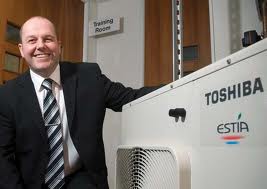
They claim that in most cases there is no cost involved. According to David Dunn, Toshiba Air Conditioning commercial director  “ Toshiba’s new lease scheme enables businesses to replace aging R22 plant with new high efficiency air conditioning in a budget neutral way.”

He goes on to say “The savings in running costs in the vast majority of cases pay for the lease costs on the new equipment, giving up to seven years peace of mind – plus high quality heating and cooling for building occupants.”

As with many of the latest air conditioning systems, the key to the scheme is the use of high efficiency R410A equipment to replace old R22 systems. The new plant uses much less energy to deliver the same cooling and heating to a building, dramatically reducing the user’s energy bills. They claim that in most cases, the monthly saving in running costs will equal the lease costs for the new equipment, making the replacement programme budget neutral.

It is a revolutionary way of not just resolving the R22 headache, but also to encourage commercial companies to reduce their carbon footprint now, rather than waiting until they can afford the capital investment. In many ways, this scheme reflects the ideas proposed in the governments ‘Green Deal’. The government wants businesses to install modern air conditioning (and heating), then pay for it through their electricity bill, based on the savings that are made in electricity. Where the ‘Green Deal’ differs from the Toshiba scheme is that the ‘Green Deal’ proposes that businesses pay back the investment through their electricity bills (see our article How the Governments “Green Deal” affects UK businesses).

In principle we really like what Toshiba are doing here and I very much expect that the other manufacturers will follow suit with schemes of their own. Toshiba have sweetened the deal even further by offering warranties for up to 7 years on the leased equipment, removing uncertainty on servicing and maintenance costs and delivering guaranteed monthly expenditure for budgeting purposes.

Toshiba already reports keen interest in the scheme from a number of major end users operating national estates still dependent on R22-based air conditioning. A key attraction in the current economic climate is that the scheme solves the R22 problem without requiring upfront investment in capital costs. Our only observation at this stage is that the equipment cost of a new installation is often only a 1/3 of the overall cost. So do the lease payments factor in all the other costs associated with a new install – I would expect so, but you will need to read the small print?

There is also a counter argument that it may be worth waiting to see the exact shape and form of the Governments ‘Green Deal’ as it is finalised later in the year. Although, don’t hold your breath – its already been delayed more than once and time is running out to replace those old R22 systems.

Mitsubishi Air-to-water Heat Pump

Mitsubishi Heavy Industries (MHI) has entered the UK heat pump market with an innovative product range they call Hydrolution – These  air-to-water systems build on the high efficiency DC inverter technology used for in their air conditioning units. The heat pump and hot water storage system achieves an impressive CoP of 4.08 in heating mode, and is specifically designed from easy installation as the Hydrolution units are pre-charged with refrigerant – a major advantage over some heat pump systems where the installer needs refrigeration gas handling certification.

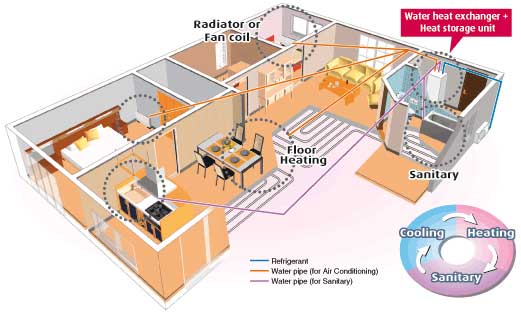
The MHI Hydrolution is a complete system for space heating and hot water production in domestic and smaller commercial buildings. Water is heated and stored at up to 45°C – 58°C by operating the outdoor heat pump and this can be topped up on demand to 65°C by the unit’s integral 9kW immersion heater, or any connected external source, such as a conventional gas boiler or solar panels. Alternatively, in hot weather the heat pump can be ‘reversed’ to chill water for underfloor cooling.

As an air-to-water heat pump, MHI’s Hydrolution uses ‘free’ outdoor air energy to heat water, albeit at a lower temperature than a standard boiler system would; this makes Hydrolution particularly suitable for underfloor heating systems. It can be plumbed into a building without the cost and disruption associated with installing ground source heat pumps, such as digging bore holes and laying coils.

We were impressed with how compacted the Hydrolution heat pump is.  The outdoor unit is about the size of a large suitcase and can be wall or floor mounted in any convenient position up to 12m from the indoor hot water storage unit. With a footprint of 600mm x 650mm the indoor unit is easy to install even where space is limited, and incorporates a 270 litre storage cylinder, circulating pump and immersion heater.

In the face of rising energy costs and growing pressure for greener buildings, heat pumps are proven to provide a reliable renewable energy option for space heating and sanitary hot water production. MHI’s European Sales Manager, Des Franklin, comments: “MHI has developed Hydrolution specifically for the UK and European heating markets where heating engineers might not have air conditioning refrigerant handling expertise. An exciting new concept in heat pump technology, Hydrolution offers all the benefits of high efficiency with ultra simple installation”.

In summary for the techies:

  • The outdoor unit FDCW100VNX retrieves the heat energy from outdoor air (heat source) and increases its temperature through compressing process by compressor.
  • The hot refrigerant (now in gas state) is routed to HM270V
  • The refrigerant releases the heating energy to water for further distribution in the climate system.
  • The refrigerant (now in liquid state) is routed back to FDCW100VNX and this process is repeated. By reversing the entire process for cooling, the refrigerant in this system retrieves the heat energy from water and releases it to outdoor air in accordance with heat pump theory.
  • HM270V determines when FDCW100VNX is to run or not to run by using the collated data from the temperature sensor. In the event of extra heat demands, HM270V can utilize additional heat in the form of the immersion heater, or any connected external addition.
  • Optimum annual operation costs thanks to the inverter driven compressor. The speed of the compressor is controlled according to the demand, and the industries highest COP level of 3.70 in heating operation has been achieved.
  • The compact size (600x650mm footprint) has been achieved by integrating the hot water tank for sanitary water together with the water heat exchanger in indoor unit. Electric wiring and piping works are simpler due to integrated indoor unit design.
  • Max temperature flow line is 65°C with use of a large-capacity auxiliary electric heater as standard equipment for back-up so that the system will be able to cope with irregular and excessive use of hot water. (58°C with only use of compressor)
  • Various sterilization temperature settings according to the requirements of each country.
  • Possible to connect external heating sources including solar collectors.
  • List price ~£5300