
Archives for April, 2012

How the Governments “Green Deal” affects UK businesses

Currently, a quarter of the UK’s carbon emissions come from our businesses, industry and workplaces. So the Green Deal is the latest environmental initiative from the British government. It aims to encourage domestic and business energy users to reduce their energy consumption by installing energy efficient measures such insulation, air conditioning heat pumps,  condensing boilers to name a few.

Although the Green Deal is being launched in October 2012, the Government has confirmed that many businesses will be unable to take advantage of the Green Deal loan scheme. A spokeswoman for the Department of Energy and Climate Change (DECC) has said that “the Green Deal for businesses would be delayed because the requirements for commercial properties would be more complex than for domestic buildings”. DECC has not yet set a date for the launch of the business element of Green Deal, however the spokeswoman suggested “it would happen shortly after the domestic loan scheme”.

 The Green Deal philosophy:

Under the Green Deal, bill payers (tenants and owner occupiers) will be able to install energy efficiency improvements without having to front up the cash. Instead, businesses will provide the capital, getting their money back via the energy bill. At the heart of the offer is a simple rule: estimated savings on bills will always equal or exceed the cost of the work.

Will it become a regulatory requirement?

The Government paper “The Green Deal”  (section 2.1.3) suggests that “It is important that the sector has the opportunity to make voluntary improvements first, and that regulation is only deployed if necessary to improve the energy efficiency…”. It goes on to suggest that secondary legislation would be required to force owners and landlords to make energy improvements and the earliest date regulations could come into force is April 2015.

The paper then goes onto say that the Government are proposing powers to require landlords to bring their property up to a defined threshold before it can be rented out again. They caveat this by saying “subject to there being no up-front financial cost to landlords”.

The Governments view seems to be that commercial rented properties change hands relatively frequently, and so this condition would catch most properties. Landlords with the worst performing commercial properties would have to complete a Green Deal assessment and then implement a sufficient number of the cost-effective improvements identified to bring the energy performance of the property up to the threshold. If insufficient cost effective improvements were found, the landlord would still have to implement all of them but would not be required to meet the minimum standard.!

 How will it all work in practice?

As I mentioned earlier, the government appears to need more time refining exactly how the Green Deal will work for businesses, but I would expect it to be along the following this lines (also diagram at the end of this blog):

Property assessments: One of the prerequisites for a Green Deal plan will be for the consumer to have a property assessment by an accredited adviser. The adviser would visit to assess the energy performance of the property and advise on the relevant opportunities for energy efficiency improvements.  Yes, this all sounds a bit like the current EPC (Energy Performance Certificate) and it appears likely that the Government will use an improved version of the EPC for the purposes of Green Deal assessments.

Make recommendations: Assessors will make recommendations drawn from a list of energy improvement measures which have been approved for the Green Deal. These measures will include a corresponding list of products, materials and specification standards in the form of a Code of Practice. It seems this Code of Practice will be essential to ensure there is no conflict of interest between assessors and Green Deal Providers. Despite this, I can’t help thinking this is a potential area for unfair or misleading selling practices, but we will have to see!.

Green Deal Providers quote for the work: the Green Deal Provider would consider the package of measures and make an offer which stipulates the total cost, the charge to be attached to the energy meter, and the length of the repayment period.

 Arrange financing: Consumers will be free to finance work as they wish, and some people may opt to pay for the work upfront, in whole or in part. But what the Government hopes will make the Green Deal attractive is the opportunity to repay through energy bills, spreading the cost and enabling the obligation to repay to be passed on to future occupiers.

I could also write a long blog on this subject alone and still not cover it properly. But I will close this section by saying the Government appears to want to encourage a wide range of financial institutions and High Street names into offering Green Deal finance.

Install the energy improvement measures: Certification of installers will be an essential element of this, as work will be undertaken by a range of trades people. The proposed standards and certification framework is intended to ensure that all work is completed to a recognised standard and that consumers can expect the same level of customer care and protection regardless of the installer. The Government appears to be suggesting the energy improvement providers will need to qualify and carry a quality logo similar to existing marks such as Gas Safe and Trustmark.

Repayments: When the Green Deal installer has completed the work, they will inform the Green Deal provider (if it is a separate organisation) who will arrange for details about the Green Deal to be included in an updated EPC or other appropriate document and lodged on the EPC or equivalent database. The Green Deal provider would also pass the relevant details to the customer’s energy supplier. Following verification by the energy supplier, which would give the customer the right to query any details, the Green Deal charge would appear on the next energy bill received by the customer.

 the green deal


We are listed in the following top directories;
Free Web Directory

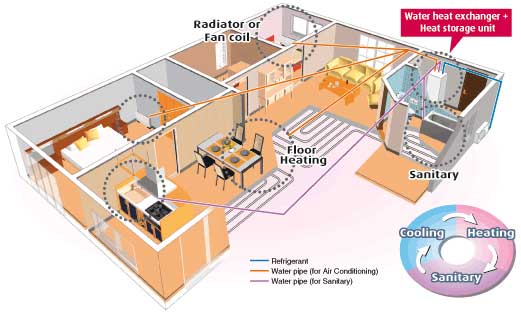
Mitsubishi Air-to-water Heat Pump

Mitsubishi Heavy Industries (MHI) has entered the UK heat pump market with an innovative product range they call Hydrolution – These  air-to-water systems build on the high efficiency DC inverter technology used for in their air conditioning units. The heat pump and hot water storage system achieves an impressive CoP of 4.08 in heating mode, and is specifically designed from easy installation as the Hydrolution units are pre-charged with refrigerant – a major advantage over some heat pump systems where the installer needs refrigeration gas handling certification.

The MHI Hydrolution is a complete system for space heating and hot water production in domestic and smaller commercial buildings. Water is heated and stored at up to 45°C – 58°C by operating the outdoor heat pump and this can be topped up on demand to 65°C by the unit’s integral 9kW immersion heater, or any connected external source, such as a conventional gas boiler or solar panels. Alternatively, in hot weather the heat pump can be ‘reversed’ to chill water for underfloor cooling.

As an air-to-water heat pump, MHI’s Hydrolution uses ‘free’ outdoor air energy to heat water, albeit at a lower temperature than a standard boiler system would; this makes Hydrolution particularly suitable for underfloor heating systems. It can be plumbed into a building without the cost and disruption associated with installing ground source heat pumps, such as digging bore holes and laying coils.

We were impressed with how compacted the Hydrolution heat pump is.  The outdoor unit is about the size of a large suitcase and can be wall or floor mounted in any convenient position up to 12m from the indoor hot water storage unit. With a footprint of 600mm x 650mm the indoor unit is easy to install even where space is limited, and incorporates a 270 litre storage cylinder, circulating pump and immersion heater.

In the face of rising energy costs and growing pressure for greener buildings, heat pumps are proven to provide a reliable renewable energy option for space heating and sanitary hot water production. MHI’s European Sales Manager, Des Franklin, comments: “MHI has developed Hydrolution specifically for the UK and European heating markets where heating engineers might not have air conditioning refrigerant handling expertise. An exciting new concept in heat pump technology, Hydrolution offers all the benefits of high efficiency with ultra simple installation”.

In summary for the techies:

  • The outdoor unit FDCW100VNX retrieves the heat energy from outdoor air (heat source) and increases its temperature through compressing process by compressor.
  • The hot refrigerant (now in gas state) is routed to HM270V
  • The refrigerant releases the heating energy to water for further distribution in the climate system.
  • The refrigerant (now in liquid state) is routed back to FDCW100VNX and this process is repeated. By reversing the entire process for cooling, the refrigerant in this system retrieves the heat energy from water and releases it to outdoor air in accordance with heat pump theory.
  • HM270V determines when FDCW100VNX is to run or not to run by using the collated data from the temperature sensor. In the event of extra heat demands, HM270V can utilize additional heat in the form of the immersion heater, or any connected external addition.
  • Optimum annual operation costs thanks to the inverter driven compressor. The speed of the compressor is controlled according to the demand, and the industries highest COP level of 3.70 in heating operation has been achieved.
  • The compact size (600x650mm footprint) has been achieved by integrating the hot water tank for sanitary water together with the water heat exchanger in indoor unit. Electric wiring and piping works are simpler due to integrated indoor unit design.
  • Max temperature flow line is 65°C with use of a large-capacity auxiliary electric heater as standard equipment for back-up so that the system will be able to cope with irregular and excessive use of hot water. (58°C with only use of compressor)
  • Various sterilization temperature settings according to the requirements of each country.
  • Possible to connect external heating sources including solar collectors.
  • List price ~£5300

Cooling and how air conditioners work

Cooling is the transfer of heat energy via radiation, conduction or convection. But how does cooling really work in air conditioning systems.

Air conditioning cooling systems take advantage of a very clever physical law. When a liquid converts to a gas, it absorbs heat and conversely, when a gas converts to liquid, it releases heat.

Air conditioning systems use these principles over and over again to move heat from one location to another (e.g. from indoors to outdoors). In very simple terms, they use a closed loop of pipes to circulate a compound. Within this system is a compressor to convert the compound to a gas (therefore absorbing heat) and an expansion valve to convert it back to liquid (releasing heat). It’s a little more complicated than that, but if you keep that simple concept in mind when reading the rest of this article.

Before we move on, just to let you know the compounds cooling systems use are known as refrigerants which have special qualities that allow them to change from liquid to gas (and vice versa) at much lower temperatures, thus better facilitating the cooling process. So here goes in a bit more detail:

Cooling

1. When hot internal air flows over the cold, low-pressure internal evaporator coil (more commonly known as the internal air handling unit), the refrigerant inside absorbs heat and as it does so, it changes from a liquid to a gas.

2. To keep cooling efficiently, the air conditioner has to convert the refrigerant gas back to a liquid again. To do that, a compressor puts the gas under high pressure, a process that creates unwanted heat.

3. All the extra heat created by compressing the gas is then evacuated to the outdoors with the help of a second set of coils called condenser coils, and a second fan. As the gas cools, it changes back to a liquid.

4. The liquid refrigerant runs through an expansion valve, and in the process it evaporates to become a very cold, low-pressure gas. This is feed back into air handling unit and the process starts all over again.

It’s easy to see that there are two distinct things going on in an air conditioner. Refrigerant is chilling the indoor air, and the resulting gas is being continually compressed and cooled for conversion back to a liquid again.

Now lets look at the various components of  a cooling air conditioner in more detail:

The compressor (which is controlled by the thermostat) is at the ‘heart’ of the system. It acts as the pump, causing the refrigerant to flow through the system. Its job is to draw in a low-pressure, low-temperature, refrigerant in a gaseous state and by compressing this gas, raise the pressure and temperature of the refrigerant. This high-pressure, high-temperature gas then flows to the condenser coil.

The external condenser coil is a series of piping with a fan that draws outside air across the coil. As the refrigerant passes through the condenser coil and the cooler outside air passes across the coil, the air absorbs heat from the refrigerant which causes the refrigerant to condense from a gas to a liquid state. The high-pressure, high-temperature liquid then reaches the expansion valve.

The internal evaporator coil is a series of piping connected to a furnace or air handler that blows indoor air across it, causing the coil to absorb heat from the air. The cooled air is then delivered to the house through ducting. The refrigerant then flows back to the compressor where the cycle starts over again.

The internal ‘Air handling Unit’ of an air conditioner contains the evaporator and a fan that blows air over the chilled coils and into the room. The external part of the air conditioning unit contains the compressor, condenser and another fan to vent hot air coming off the compressed refrigerant to the outdoors.

In between the two sets of coils, there’s an expansion valve. It regulates the amount of compressed liquid refrigerant moving into the evaporator. Once in the evaporator, the refrigerant experiences a pressure drop, expands and changes back into a gas. The compressor is actually a large electric pump that pressurizes the refrigerant gas as part of the process of turning it back into a liquid. There are some additional sensors, timers and valves, but the evaporator, compressor, condenser and expansion valve are the main components of an air conditioner.

Described above is a conventional setup for an air conditioner and it is known as a ‘split’ system.